

Over the years, Japanese corporations have undergone a transformative shift in their overseas expansions, evolving from simple trade engagements to more intricate collaborations, embracing open innovation. While this trend has gained momentum globally, collaborations between Japan and Australia in the innovation domain remain relatively limited, yet they are on the rise.
Within the Australia-Japan realm, the “energy-heavy” relationship has evolved across two related dimensions — “what?” and “who?” — with more stakeholders such as universities and startups garnering the limelight. This article intends to put the spotlight on such examples.
The wider objective of this piece is our contribution to a conversation about increasing the A-J innovation success cases in the Australia-Japan corridor. Specifically, IGPI shares some of its observations of the potential bottlenecks faced by the Japanese side between the HQs and local arms of Japanese corporations. These are internal and complex matters that by no means have easy fixes.
1. Brief Snapshot of A-J Relationship Thus Far…
It is no secret that Japan and Australia have cultivated a longstanding and complementary trading relationship, underscored by traditional sectors such as energy, agriculture, and mining. In 2022, Australia contributed to Japan’s resources by supplying Japan with 43% of its liquefied natural gas (LNG) and 66% of its coal, with a predominant share of 75% in thermal coal[1]. On the other side, 7% of total Australian imports comes from Japan, including vehicles, machineries, and electronics (as of Dec 2023)[2]. Japan and Australia have built their relationship on comparative advantages, with Australia serving as a raw materials supplier and Japan as a manufactured goods producer[3].
2. How Is the Nature of Partnership(s) Evolving Between Australia & Japan?
The nature of the “energy-heavy” partnership between Australia and Japan is evolving in two related dimensions — these are “what?” and “who?” referring to needs and players, respectively.
2.1. Evolving Needs (“What”?)
Japan is a highly developed nation but lacking in natural resources, and Australia possesses abundant natural resources that can complement Japan’s requirements. Japan drew up a national strategy to achieve net-zero carbon emissions by 2050[4], which encompasses a systematic transition from traditional fossil fuels to initiatives such as renewable energy generation and hydrogen transportation. While traditional energy sources will continue to play a role in Japan’s energy strategy in the mid-term, the trend towards a long-term transition to decarbonization is steadfast. In this global trend towards decarbonization and a sustainability focus, collaborations between two nations are widening. Some examples:
| “What?” | Brief Example |
|---|---|
| From Energy to Technology |
Although energy remains a high focal point for now, the collaboration paradigm has evolved from traditional resources like coal to a shift towards cutting-edge technologies such as hydrogen transportation. One notable example is LAVO, an Australian energy storage and technology startup that integrated Artificial Intelligence (AI)-enabled digital solutions, which supplied its metal hydride storage technology to the leading Japanese trading house Marubeni Corporation. This will lead to the export of Australian green hydrogen. This collaboration established a precedent as the first of its kind to demonstrate the profitability and safety of exporting Australian renewable hydrogen stored in metal hydride to international market[5]. |
| From Procurement to Co-development |
The goal of decarbonization also drives Japan’s investment from procurement to business or technical collaboration for co-developing innovative technologies. Japanese corporations such as JX Nippon Oil & Gas Exploration Corporation, Mitsui O.S.K. Lines, and Osaka Gas have partnered with Australian corporations, including Future Energy Exports CRC, deepC Store, and Low Emission Technology Australia, along with Australian universities such as the University of Western Australia and Curtin University. Together, they have formalized a Project Agreement aimed at collaborative research and development on low-pressure and low-temperature solutions for the bulk transport shipment of CO2. This is to showcase the technical feasibility and operational viability of the solutions and ultimately advancing technologies for the secure and efficient shipment of substantial quantities of CO2[6]. |
2.2. Evolving Partnerships (“Who”?)
The transition of “what” is marked by widening of the players. While mega corporations once held a dominant position, the Australia-Japan collaboration is now witnessing increased participation from innovative participants such as universities and startups.
Australia’s innovation network is characterized by a highly complex yet proactive landscape, where collaborations and partnerships evolve to meet the demands of a rapidly advancing technological era. The collaborative partners between Japan and Australia are in a state of transition from (i) “Corporations x Corporations” to also include (ii) “Corporations x Universities”, (iii) “Corporations x Startups” and (iv) “Universities x Universities”. It symbolizes the growing realization of the strengths of Australian universities and startups, which Japanese corporations can leverage upon for mutual benefit. Some examples:
| “Who?” | Brief Example |
|---|---|
| Corporations x Universities |
Macquarie University, a world-leading AI research powerhouse, and Fujitsu, a leading Japanese information and communication technology corporation, have together announced their establishment of AI Research Laboratory at Macquarie University. By utilizing the strengths of each other — the university’s research capabilities and Fujitsu’s generative AI and human sensing technologies — the focus is on researching and developing promising AI applications and related technologies for the society[7]. |
| Corporations x Startups |
Morse Micro, an Australian fabless semiconductor startup reinventing Wi-Fi for IoT, secured Series B funding from a consortium of investors led by the Japanese ASIC and system-on-a-chip (SoC) developer MegaChips. Following this investment, MegaChips entered a partnership with Morse Micro to produce compliant semiconductors and modules, offering assurance, sales support, and new distribution channels. This came about because both Morse Micro and MegaChips share a common goal of revolutionizing IoT connectivity by innovating connectivity and establishing robust Wi-Fi HaLow solutions for the future[8]. |
| Universities x Universities |
UTS (University of Technology Sydney), with pioneering food tracking technology, has shared the technology to the Wagyu beef farmers in both Australia and Japan. As part of the project Hokkaido University, the partner in the project supported the relationship between Australia and Japan on technology promotion. The project aimed to provide IoT and blockchain-enabled capabilities to the food supply chain market[9]. |
These select examples corroborate the fact that Japanese corporations are increasingly taking note of Australia’s innovation potential. The complementing strengths and common goal synergies can lead to collaboration not only limited to Australia or Japan but in the wider region/world. For this to happen at scale, a long-term view of investment and nurturing is critical. Corporations and stakeholders must actively address these aspects to incubate and support the growth of innovative ideas and technologies.
3. Giving More Flavor to the Diversity of the Diverse A-J Innovation Partnerships
It is also noteworthy to share that these collaborations take place across diverse sectors and typically are in some combination of business, technical, and financial partnership. Apart from the well-known and time tested (i) “Corporations to Corporations”, some more examples occur across (ii) “Corporations x Universities”, (iii) “Corporations x Startups” and (iv) “Universities x Universities”.
3.1. Corporations x Universities – Examples
| Date | Type | Sector | Japanese Entity | Australian Entity | State | Quick Overview |
|---|---|---|---|---|---|---|
| Sep-23 |
Technical |
Data Security |
NTT |
UTS |
NSW |
NTT and UTS are collaborating to address data security risks collectively, integrating state-of-the-art encryption technology[10]. |
| Jun-23 |
Technical |
Smart City |
NEC Australia |
University of Wollongong |
NSW |
A strategic alliance aimed at jointly spearheading smart city initiatives within the Illawarra region[11]. |
| Apr-23 |
Technical |
Smart Automotive |
IDOM |
RMIT |
VIC |
Collaboration on multiple specialized initiatives dedicated to the advancement of intelligent automotive solutions through the utilization of emerging technologies[12]. |
| Jul-22 |
Technical |
Carbon Neutrality |
Nippon Steel |
University of QLD |
QLD |
Joint research proposal between Nippon Steel and University of QLD aiming to transform CO2 into valuable chemicals through synergistic application of microbial and electrochemical processes[13]. |
| Nov-21 |
Technical |
Hydrogen |
Chiyoda Corporation, ENEOS |
QUT |
QLD |
Jointly announced a ground-breaking achievement of the first-ever successful technological verifications for CO2-free hydrogen to a practical level at scale[14] |
Table 1. Collaboration between Japanese Corporations and Australian Universities
3.2. Corporations x Startups – Examples
| Date | Type | Sector | Japanese Entity | Australian Entity | State | Quick Overview |
|---|---|---|---|---|---|---|
| Mar-23 |
Financial |
Automated Driving |
Suzuki Motors |
Applied Electric Vehicles |
VIC |
Suzuki Motors and Applied Electric Motors Electric Vehicles have signed an MoU to develop an autonomous electric vehicle platform[15]. |
| Oct-22 |
Business |
AI |
Macnica Inc. |
icetana |
WA |
Macnica has secured a strategic stake in icetana, a leading artificial intelligence software developer. As part of this deal, Macnica will assume the role of the exclusive distributor for icetana in the Japanese and Brazilian markets[16]. |
| May-22 |
Technical |
Engineering Design |
Sumitomo Mitsui Construction (SMCC), IHI |
Roborigger |
WA |
SMCC and IHI are collaborating with Roborigger to design and develop the first autonomous tower crane[17]. |
| Dec-21 |
Business |
Medial |
Terumo Corporation |
Q-Sera |
QLD |
Q-Sera, a University of QLD startup, specializing in the development of rapid serum blood collection tube technology, is set to manufacture and deploy its innovation in Japan. This comes after forming a partnership with Terumo Corporation, Japan’s leading medical device company[18]. |
| Dec-19 |
Technical |
Blockchain |
Kansai Electric Power Co Inc. (KEPCO) |
Powerledger |
WA |
Powerledger has expanded its trial in collaboration with KEPCO to facilitate the creation and tracking of Renewable Energy Certificates (RECs) as well as solar energy trading[19]. |
Table 2. Collaboration between Japanese Corporations and Australian Startups
3.3. Universities x Universities – Examples
| Date | Type | Sector | Japanese Entity | Australian Entity | State | Quick Overview |
|---|---|---|---|---|---|---|
| Oct-23 |
Financial |
Laser Tech |
EX-Fusion, Osaka University |
University of Adelaide |
SA |
The University of Adelaide has partnered with EX-Fusion, a leading Japanese laser fusion startup, and the Institute of Laser Engineering at Osaka University to advance laser technology for clean fusion energy[20]. |
| Nov-22 |
Business |
Photovoltaic |
Kyoto University, |
RMIT University |
VIC |
This project aims to enhance an existing collaborative research network between Australia and Japan to develop next generation solar cells known as perovskite solar cells[21]. |
| Feb-22 |
Technical |
Telecommunications (6G) |
Osaka University, |
University of Adelaide, |
SA, |
These universities synergize essential capacities to advance 6G telecommunications, addressing the anticipated surge in data traffic by 2030[22]. |
| Jul-21 |
Business |
Robotic |
University of Tokyo |
University of Sydney |
NSW |
This forum aims to discuss the use of urban robots in public spaces, inviting scholars from Australia and Japan to exchange the latest smart technologies. It also aims to promote ongoing collaboration among researchers in innovation and technology from both countries[23]. |
| May-20 |
Technical |
Carbon Neutrality |
University of Tokyo |
University of Queensland |
QLD |
Realize the goal of “Nanoarchitectured Functional Porous Materials as Adsorbents and Catalysts” to reduce greenhouse gas levels, mitigating global warming and converting them into valuable chemicals[24]. |
Table 3. Collaboration between Japanese Universities and Australian Universities
4. What Are the Bottlenecks for Japanese Corporations in Increasing the Number of Success Cases?
The nature of Japanese corporation’s associations varies significantly. Regardless of size, corporations may have had extensive length of association with Australia (over multiple decades) or extremely short time. However, the key issue faced in boardrooms is the depth of “Why Australia?” within that corporation and “how motivated” they are to explore such opportunities. IGPI has seen in many cases that the local arm understands the potential on one side but is challenged to convince HQ/RHQ to take any further action (e.g., strategic alignment, etc.). On the other hand, the RHQ/HQ looks at various countries and is not always clear on “Why Australia?” etc., and doesn’t offer much support to the local arm (e.g., funding, human capital dispatch, etc.).
So, the key is addressing these complex and layered internal issues to get the ball rolling. Based on IGPI’s diverse experiences of working with Japanese corporations’ HQs and various in-market offices, as well as supporting JETRO for a case study, there are eight key elements that need to be addressed for smoothly exploring innovation opportunities in a cross-country setting. It usually begins with alignment on strategy, mission, vision, and values (MVVs).
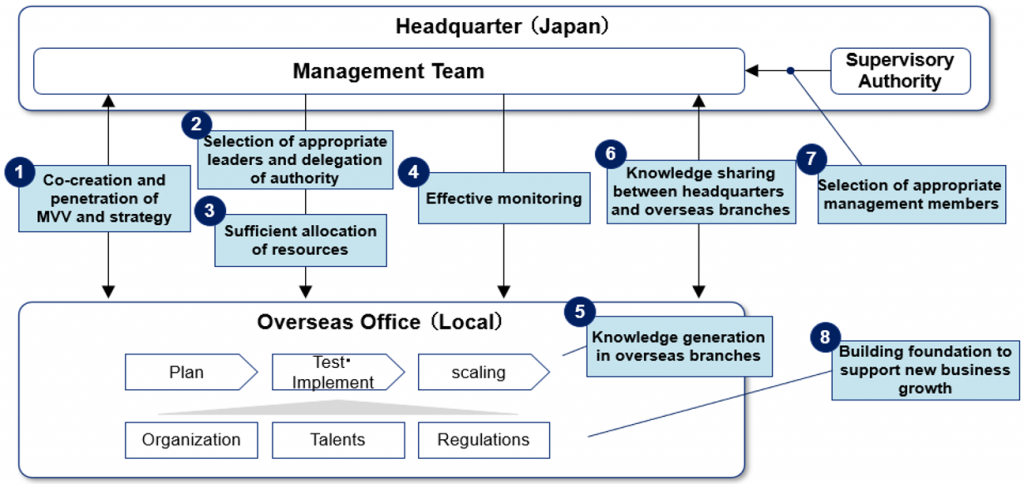
Image: JETRO Case Study Summary Report[25]
Regardless of the Japan or Australia side, unless the counter-country element is identified as part of the future, there will be misalignments, lack of actions, and/or insufficient implementation.
There are notable companies that have already overcome such challenges. For example, companies like NTT and Fujitsu have defined Australia as a “Testbed” market. In NTT’s case, Australia’s unique geographic landscape was perfect for developing next-gen agricultural sensing and communication technologies — with proactive consumers to test new technologies[26]. And in Fujitsu’s case, setting up a “Digital Transformation Center” within Macquarie University in Sydney was to take advantage of the university’s capabilities directly for ideation and co-creation of new solutions for customers — exemplifying the benefits from the diversity of talents[27].
These are examples of “Defining a clear role for Australia”, but high in impact to enable HQ/RHQ and local arm alignment.
5. How Can IGPI Australia help?
IGPI Group has developed a deep-rooted understanding of Japanese corporations and has been a part of the global expansion and ambitions of many prominent companies across APAC and beyond. If you are a Japanese HQ or a local arm and believe in the potential of Australia-Japan based on the pillars of innovation but feel constrained due to any or all of the eight elements in this article, we will be glad to have a confidential conversation. IGPI provides highly customized business advisory to its diverse range of clients, including but not limited to:
-
- Internal alignment initiatives of HQ & local arms
- Open innovation roadmap
- New business creation support
- Market assessment for business opportunities
- Strategic partner/capabilities search
- Commercial negotiations support
- Other custom hands-on support (in-market)
==========
[References]
[1] https://japan.embassy.gov.au/tkyo/resources.html
[2] https://tradingeconomics.com/australia/imports
[3] https://www.aph.gov.au/Parliamentary_Business/Committees/Senate/Foreign_Affairs_Defence_and_Trade/Completed_inquiries/1999-02/japan/report/c05
[4] https://www.meti.go.jp/english/policy/energy_environment/global_warming/roadmap/
[5] https://www.lavo.com.au/blog/marubeni-lavo-exporting-hydrogen
[6] https://www.fenex.org.au/australian-japanese-partners-execute-rd-project-agreement-to-develop-safe-and-efficient-solutions-for-industrial-scale-shipping-of-co2/
[7] https://www.fujitsu.com/au/about/resources/news/press-releases/2023/fujitsu-and-macquarie-university-establish-new-research-lab-to-accelerate-development-of-human-sensing-and-generative-ai-technologies.html
[8] https://www.morsemicro.com/2022/09/06/morse-micro-raises-140m-in-series-b-funding-to-accelerate-iot-connectivity-and-revolutionize-our-digital-future/
[9] https://www.uts.edu.au/about/faculty-engineering-and-information-technology/global-engagement/international-news/tracking-technology-wagyu-beef
[10] https://www.uts.edu.au/about/faculty-engineering-and-information-technology/news/ntt-data-uts-partner-enhance-data-security-research
[11] https://www.uow.edu.au/media/2023/uow-and-nec-australia-join-forces-to-drive-smart-city-innovations-in-the-illawarra-.php
[12] https://idomi.com.au/2023/04/20/idom_rmit_partnership/
[13] https://www.nipponsteel.com/en/news/20220722_100.html
[14] https://www.eneos.co.jp/english/newsrelease/2021/pdf/20211102_01.pdf
[15] https://www.appliedev.com/suzuki-press-release-30-march-2023
[16] https://www.icetana.ai/investor-updates/global-technology-giant-macnica-takes-strategic-investment-in-icetana
[17] https://www.roborigger.com.au/sumitomo-mitsui-construction-teams-with-roborigger/
[18] https://uniquest.com.au/rapid-serum-blood-collection-technology-developed-by-uq-startup-q-sera-to-be-made-in-japan/
[19] https://www.powerledger.io/media/power-ledger-kepco-extend-trial-to-create-and-track-renewable-energy-credits
[20] https://www.adelaide.edu.au/newsroom/news/list/2022/12/14/fusion-of-expertise-aims-to-develop-sovereign-capability
[21] https://www.dfat.gov.au/people-to-people/foundations-councils-institutes/australia-japan-foundation/grants/2021-22-grantees
[22] https://www.dfat.gov.au/people-to-people/foundations-councils-institutes/australia-japan-foundation/grants/2021-22-grantees
[23] https://www.dfat.gov.au/people-to-people/foundations-councils-institutes/australia-japan-foundation/grants/meet-our-2020-21-grantees
[24] https://japantoday.com/category/tech/first-grant-awarded-under-rio-tinto-australia-japan-collaboration-program
[25] JETRO “Case Study on Management Innovation of Japanese Companies in Southeast Asian Markets and Identification of Key Points” Summary Report
[26] https://www.foodagility.com/posts/australia-the-testbed-for-new-green-iot-technologies
[27] https://corporate-blog.global.fujitsu.com/apac/2019-12-20/digital-transformation-centre-brings-co-creation-to-life-in-australia/