


Vietnam is one of the fastest-growing economies in Southeast Asia with rising middle class and a tech-savvy young generation. The country has increasingly witnessed a change in consumer demand for higher quality and value goods and services. This phenomenon can be clearly observed across sectors such as agriculture, healthcare, financial and education sector – offering a number of opportunities to be touched upon by established Australian businesses and startups with newer and more advanced technology.
What makes Vietnam an attractive destination?
Vietnam is among the most dynamic emerging countries in the East Asia region[1]. The transformation of its economy since the 1990s has lifted Vietnam from one of the poorest countries 25 years ago into a middle-income country[2]. Vietnam’s economic growth was ranked second in 2019 and first in 2020 (Figure 1) amongst its peers in Southeast Asia – one of the few countries in the world to achieve a positive GDP growth rate (2.9%) during the Covid-19 pandemic.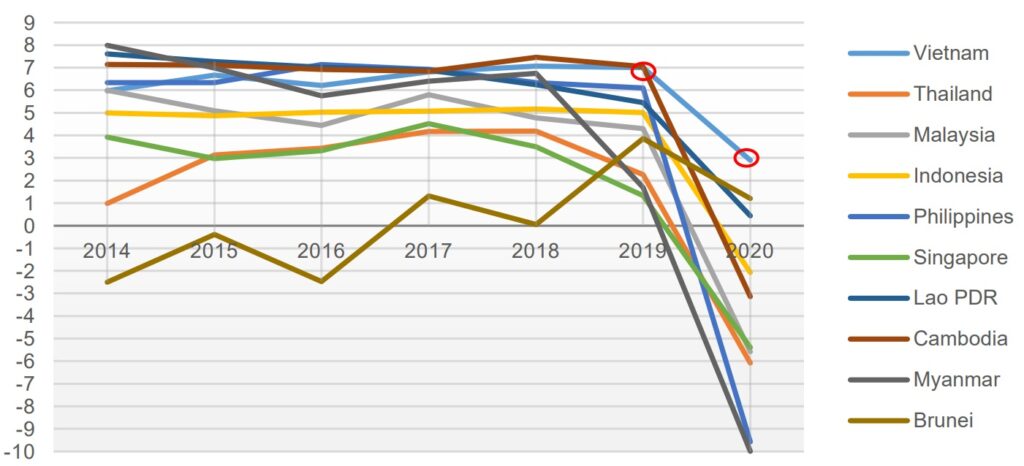
Figure 1: GDP growth rate of ASEAN countries during 2014 – 2020[3]
Vietnam’s economic growth is driven by export-oriented manufacturing, foreign direct investment and increasing domestic consumption demand.
-
- Exports increased at a remarkable average annual rate of 12.8% during 2015 – 2019 and nearly 5% in 2020[4], allowing Vietnam to enjoy a trade surplus for 5 consecutive years from 2016 to 2020.
- FDI inflows in Vietnam witnessed constant growth and achieved USD 16.1 billion in 2019[5]. Over 70% of FDI is accounted by technology manufacturing sector, indicating that Vietnam is being considered as the new manufacturing hub in Asia[6] with the advantages of cost-competitive labour, young population, investment incentives and preferential treatment created by various Vietnam’s FTAs such as CPTPP and RCEP.
- Vietnam’s population is expected to expand to 120 million by 2050 from 96.5 million in 2019[7]. The workforce is young, dynamic, better educated and digital-savvy.
Vietnam has a high internet penetration rate of 68.7% (among total population in 2019) and the middle class is expected to reach 26% of the population by 2026[8], making it an attractive destination for foreign brands to provide high value-added products and services.
How does Australia – Vietnam bilateral trade relationship facilitate Australian businesses?
Vietnam and Australia have a strong bilateral trade relationship. The agreement of two countries in August 2019 to develop the Enhanced Economic Engagement Strategy (published in Dec’21) with the aim of becoming top 10 trade partners and doubling bilateral investment[9] reinforced the relation.
The two countries are currently partners under a growing network of free trade agreements (FTAs):
– ASEAN-Australia-New Zealand Free Trade Area (AANZ)
– Comprehensive and Progressive Agreement for Trans-Pacific Partnership (CPTPP)
– Regional Comprehensive Economic Partnership (RCEP)
Australia was the 14th largest export market of Vietnam in 2020 (major exports include coal, education, iron ore, live animals, wheat, aluminium, steel, meat and fruits etc.). The total two-way trade between Vietnam and Australia in 2020 was USD 8.0 billion, of which USD 4.42 billion was from Australia and USD 3.62 billion was from Vietnam[10].
Opportunities for doing business in Vietnam
1. Agriculture
Agriculture is an important economic sector in Vietnam (contributing 14.9% to Vietnam’s GDP in 2020)[11]. Science and technology are key to rising product capacity, quality of products and improving farmers’ lives. There is a rising trend that Vietnam cooperates with other developed countries’ agtech and foodtech businesses who introduce smart farming, machinery and software, the internet of things, genetic and breeding and pest management.
Key issues in Vietnam (agriculture)
- Food-borne illness and food poisoning due to bacterial contamination caused by poor hygiene.
- High use of antibiotics, pesticides and chemical fertilisers above recommended level and lack of traceability are other elements causing food safety concerns.
- Low technology adoption leads to volatility in agriculture production
Common modes of entry into Vietnam: acquisition and joint-ventures.
|
SUNRICE- One of Australia’s leading food exporters with 30 brands in 50 countries |
|
CBH Group – Western Australian grain grower co-operative |
With the rise in middle-class population expected, the Government of Vietnam is actively seeking foreign participations to shift towards high-tech agriculture applications. This support, along with CPTPP and ratification of RCEP, makes investment in Vietnam even more attractive[13]
2. Healthcare
Vietnam’s public healthcare system is organised into four levels: Central, Provincial, District and Communal. Central and provincial-level hospitals usually consist of general and specialised hospitals and medical centres. District health centres and commune health stations offer primary care alongside some medical and preventative services[14]. Vietnam’s private healthcare sector is growing. According to the Ministry of Health, the number of Vietnam’s private hospitals in 2020 was 250, accounting for 17% of the total 1,400 hospitals countrywide[15].
Key issues in Vietnam (healthcare)
- Shift of focus from communicable to non-communicable disease due to increasing prevalence of chronic diseases in Vietnam such as diabetes, cancer, cardiovascular disease and etc.
- Greater healthcare demand is expected in Vietnam as Vietnam is identified as one of the world’s fastest-ageing societies
- Overcrowding and high-occupancy rates in rural areas due to limited resources (doctors, hospital beds etc.)
Common modes of entry into Vietnam: strategic partnership and foreign direct investment.
|
Icon Group – Australia’s largest dedicated cancer care provider |
|
Cerebral Palsy Alliance (CPA) – leading Australian care and research centre for cerebral palsy and other neurological disorders |
There are growing demands for more accessible and higher-quality healthcare in Vietnam as the growing middle class is becoming more aware of their health and experience when receiving medical treatment. Australia’s advanced technology and expertise in healthcare will be able to help satisfy the demand in Vietnam.
3. Banking
Currently, Vietnam’s banking sector consists of 4 state-owned commercial banks, 31 joint-stock commercial banks, 9 wholly-foreign-owned banks, 2 joint-venture banks, 2 policy banks, 1 cooperative bank and 48 foreign bank branches. Commercial banks in Vietnam are currently engaged in a competition of using modern banking technology to provide quality services, thus attracting both Vietnamese customers and foreigners. As of 2019, there are 78 banks offering internet payment solutions, 47 banks offering mobile payment and 29 banks accepting QR code payment[20].
Key issues in Vietnam (banking)
- Vietnam has one of the lowest bank penetration rates in ASEAN- –
- Low access to credit by SMEs due to guarantees and collateral requirements
Common modes of entry into Vietnam: strategic partnership and foreign direct investment.
|
ANZ – a successful Australian bank with a proud history spanning over 175 years |
|
Raiz Invest Limited – an Australian fintech startup |
Vietnam has high digital readiness (internet penetration rate of 68.7%, mobile subscriptions of 141.2 per 100 people in 2019[21]), meaning that there is high potential for fintech solutions. To support banking digitalisation initiatives, the State Bank of Vietnam’s Steering Committee on Fintech was set up in 2017 to encourage the development of fintech.
4. Education
Traditionally, education is of great importance to the Vietnamese. Since 2000, the government has committed approximately up to 20% of public expenditure on education – one of the highest in ASEAN[22]. Vietnam’s local rising middle class prefers the private education sector over the public school method due to the better quality of services. This has translated into a strong market for private institutions and vocational schools and services.
Key issues in Vietnam (education)
- Demand for talent and highly-skilled workers in Vietnam far surpasses supply as local qualifications in many fields are not well acknowledged
- Lack of e-learning platform further limiting access to education in major cities which is further emphasized due to Covid-19 movement control
Common mode of entry into Vietnam: strategic partnership and foreign direct investment.
|
RMIT University – an internationally recognised Australian university of technology, design and enterprise |
|
English Learning Company (ELC) – an Australian award-winning English language school |
The digital economy in Vietnam is already booming, with ICT being one of the fastest-growing sectors. The high internet penetration rate, a significant number of digital consumers and a rapidly emerging middle class underpin the demand for diverse and higher-quality education in Vietnam. This condition has paved the way for Australian edtech businesses and education providers into Vietnam[24]. Particularly, edtech was among the top five most profitable areas for Vietnamese start-ups behind fintech, e-commerce, traveltech and logistics in 2018[25].
What challenges Australians may encounter in entering Vietnam?
- Difference in culture between Australia and Vietnam: Compared to Australia, Vietnam may not have a formal bidding/tenure procedure in many business scenarios. Relationships with local stakeholders such as suppliers, industry associations, local government and central ministries are key. Thus, Australian partners need to show their commitment and invest time in building trust. Third-party introduction or recommendations can be a good start.
- There are still grey areas in Vietnam laws and regulations. This may result in difficulties in interpretation, application and compliance for foreign investors. However, as part of Vietnam’s commitment to a variety of FTAs, the Government is focusing on reforming the legal system to make them consistent with international standards and result in a more business-friendly regulatory environment. Australian businesses can also find local partners to assist in understanding and complying with regulations, permits and laws.
- Corruption still remains a challenge in Vietnam. Vietnam ranked 107 (out of 180) on Transparency International’s 2017 Corruption Perceptions Index. Anti-corruption has moved up the political agenda recently. With the determination of the Government of Vietnam in anti-corruption, a new Law on Anti-corruption was issued in November 2018. The Decree guiding the implementation of the Law was passed in 2019[26], which improves Vietnam comprehensive ant-corruption legal framework.
Wrapping up
There are vast opportunities for doing business and investment in various sectors of Vietnam such as agriculture, healthcare, banking and education. The timing is ripe for both established Australian businesses and startups to engage with Vietnam. Proved to be a resilient economy, Vietnam has achieved positive economic growth instead of falling into recession like several regional peers during the Covid-19 pandemic.
With Vietnam’s strong endeavour in regulatory reform to facilitate business environment, sturdy support for digital transformation and technology transfer as well as a profound network of FTAs, expanding middle income population and a high internet penetration rate, opportunities are unfolding for Australian businesses, who are willing to participate and adapt to local market conditions, cultural difference, and leverage Australia’s distinctive advantages.
IGPI insights and how we can make a difference for Australian business?
Vietnam is one of the fastest-growing economies in ASEAN. Local government and companies are often looking for opportunities to collaborate and partner with foreign companies who possess technologies and innovations that can help solve key issues in Vietnam and create a new business. Having some form of business collaboration or partnership with local firms is one of the most popular and common ways to effectively enter a new market. Finding a suitable Vietnamese partner may be easier than you think if you get help from the right people.
We understand that the Vietnam market and corporations may not be that easy to navigate. Truth being said, there is also no “one size fit all” approach and companies need to employ different strategies based on the unique needs and environment they are operating in. IGPI has vast experience in supporting Fortune 500s, Government agencies, SMEs and funded startups across Asia and beyond for their strategic business needs, including hands-on consulting support and innovation advisory, which allows us to understand the nuances of market entry holistically. Our non-exhaustive list of capabilities to assist foreign companies entering Vietnam includes:
- Market landscape study and strategic options for go/no-go
- Custom hands-on support for strategy implementation
- Business matching support through our established network in Vietnam
==========
[References]
[1] World Bank – Vietnam overview (2021)
[2] World Bank – Vietnam: Achieving Success as a Middle-income Country (2013)
[3] World Bank – GDP growth (annual %)
[4] World Bank – Vietnam exports of goods and services (annual % growth)
[5] World Bank – Vietnam exports of goods and services (annual % growth)
[6] Austrade – Export markets: Vietnam
[7] World Bank – Vietnam overview (2021)
[8] World Bank – Vietnam overview (2021)
[9] DFAT – Vietnam country brief
[10] United Nations COMTRADE database
[11] Vietnam Briefing – Why the agtech industry will aid Vietnam’s hi-tech growth (2021)
[12] Interflour Group – About us
[13] DFAT – Business envoy (2018)
[14] WHO – Human resources for health country profiles Vietnam (2016)
[15] Vietnam Investment Review – Vietnam’s private hospital chains keep attracting foreign investment (2020)
[16] Austrade – Icon Group to pioneer treatment-plan exports to Southeast Asia
[17] Ibid.
[18] CPA – About us
[19] Austrade – Cerebral Palsy Alliance looks to Vietnam to grow its impact (2019)
[20] Austrade – Digital banking in Vietnam: A guide to market (2020)
[21] World Bank – Vietnam mobile cellular subscriptions (per 100 people)
[22] Vietnam Briefing – Education in Vietnam: Opportunities and Challenges (2020)
[23] RMIT University, About RMIT
[24] Austrade – Vietnam edtech scoping study (2020)
[25] Ibid.
[26] Baker McKenzie – Vietnam: New Decree Relating to Implementation of New Law on Anti-Corruption (2019)