


Digital transformation is necessary for businesses to stay relevant and capture new growth opportunities in their markets. Many business leaders today recognize this importance and are taking up digital transformation initiatives. However, only a very few have managed to achieve success in their digital transformation journeys and majority of them have either not taken up the necessary initiatives or are finding themselves in the digital transformation impasse due to the complexity – technological, organizational, and market wise. This article aims to present IGPI Singapore team observations, key insights and learnings from their experience in working on digital transformation initiatives in the industry.
Digital transformation is about positioning companies to fully lever the opportunities new age technologies present
As interest around digital transformation Singapore heightened, we observed that companies have started to use digital transformation loosely for their digitization initiatives which have undermined the power and importance of digital transformation. Digitization essentially refers to the process of converting information from a physical format to digital one to automate processes or workflows without any different-in-kind changes to the process itself.
Digital transformation, on the other hand, is about exploiting digital technologies to create new or modify existing business processes, customer experiences to meet changing business and market requirements. It means two things at the highest level. Firstly, digital transformation is about exploitation of what the company is already good at doing by transforming its core business using digital technologies to conduct business better, faster, cheaper and more effectively. Secondly and more importantly, it’s about building new businesses by stepping out of the core and creating something that did not exist by exploring new and adjacent business opportunities.
Irrespective of the industry, digital transformation in Singapore is a business imperative
Even if the company’s business and mission don’t change much over time, we have seen time and again that companies always need to be looking ahead for new ideas and new ways to accomplish familiar tasks because technology is a massive value creation lever and traditional competitive advantages are becoming fragile.
Technology is a massive value creation lever
In the past 15-20 years, digital technology made it cheaper for businesses to store, process, and communicate information in digital form. We also noticed that there is a positive correlation between technology investments and gross margins of a company. Our observation also aligns with the Harvard Business Review study that focused on financial services industry, which found that digital leaders outperform digital laggards by 13% in developed markets and 15% in emerging markets in yearly revenue growth[1].
Traditional competitive advantages are becoming fragile
Technology has deconstructed the links in the vertically integrated value chains of established industries and lowered significantly the barriers for entry, especially for new digital attackers. This has led to a drastic change in the competitive landscape for established companies. New startups are becoming very good at capturing value from market leaders, especially those that felt a bit too comfortable in their stable, slow-growing plateau. For instance, telco operators face challenges from players such as WhatsApp, which drastically affected their traditional short messaging service business. The advantage that companies have historically enjoyed by being the share leader of their markets is not sustainable anymore. Today, only 7% of companies that are market share leaders are also profit share leaders, down from 25%in the 1960s[2].
For a successful digital transformation, companies need a holistic approach
Exploit the core – automate existing processes and rethink how value is delivered to the end user
With increasing pressure on companies to become leaner, companies need to manage legacy businesses efficiently. While digitization can help companies with efficiency and getting to operational excellence, it must go hand in hand with enhancing customer experience. A study from the MIT Sloan School of Management found that companies that increase both digital operational excellence and customer experience outperformed industry average net margin by up to 16%[3].
For instance in 2012, AIA Singapore, a leading insurance company launched the world’s first fully mobile interactive Point of Sales (iPoS) system on iPad[4]. The adoption of iPoS went beyond the company’s expectations. Within 12 months of launch, 80% of the new business came through iPoS and the net impact to the business was three fold[5]. Firstly, agents closed more deals, secondly, turnaround times were a fraction compared to paper based approaches and finally, back office costs were much lower.
Establish a strategy to explore and exploit adjacent digital growth opportunities
Companies often focus on exploitation of their current (core) business activities and neglect the need to explore new territories and enhance their long-term viability. Instead of trying to cope with disruption when it happens, you can attack digital disruptors by creating a digital disruptor of your own by leveraging on your assets and brand to create a model disruptors cannot copy. Research shows that over a 10 year period, explorers grew 6% faster than exploiters, and delivered 2.4% higher total shareholder returns[6].
You can explore adjacent digital growth opportunities internally through R&D departments or setting up new independent business unit, or you can rely on your eco-system to source ideas externally through acquisitions, partnerships and running incubation labs.
While exploring new business opportunities however, you need to avoid the perpetual search trap – continually searching for new ideas but failing to commercialize them – by engaging in relevant innovations, selecting opportunities that fit your capabilities and focusing on monetization of the innovation.
Tetra Pak, market leader in the food processing and packaging business, best known for manufacturing of food and drinks packaging is a good example of how an established company is exploring and exploiting adjacent business opportunities. Leveraging on its market position, knowledge of the food and beverage industry, new advances in technology, Tetra Pak through its Industry 4.0 initiatives is preparing for the digitization of manufacturing. It has collaborated with other established players in the market like ABB to offer efficient energy management Industry 4.0 solutions to food and beverage industry which is expected to deliver US $500[7] billion in value by 2022.
Define organization structure and processes that support digital transformation in Singapore
Firstly, becoming digital requires a massive change in how an organization thinks and functions. For executing a digital transformation agenda, companies require a whole new set of capabilities –ambidextrous (the ability to foster both explorative and exploitative behaviors) leadership, fast execution, experimental mindset, trial and error approach.
Secondly, companies need to ensure right structural framework is in place to support the digital transformation agenda. While there is no one right approach, based on our experience, it is ideal for companies to create a separate team that is independent from the established business units to explore new possibilities, while having access to its existing corporate assets (e.g. client base). The digital activities must be allowed to run in parallel and sometimes in competition with other business units. When the new business is proved viable, it can be quickly scaled and integrated into the organization.
Last but not the least, organizations need to adopt new way of working suited to the needs of the digital age. Unlike traditional practice that follow a hierarchical structure where decision making is slow, companies must rely on small execution units and allow for more autonomy by practicing agile at scale to keep up with change. This allows companies to keep the organization adaptive over time, decreases the risk of taking the organization in the wrong direction, gives high visibility on what value every team is creating, allows companies to focus on minimum viable product at every stage and realizes business impact early with early releases and faster time to market.
Successful digital transformations in the industry are far and few
According to Forbes, 84%[8] of digital transformations failed and more than 50% did not go right at all – the gap between expectation and actual implementation were so enormous that those implementations were considered a failure. Three major reasons for those failures are described below.
Leaders fail to fully grasp the level of uncertainty in their industries when technology led disruptions are in play
Unfortunately, many business leaders underestimate the exponential progress of environments they are operating in while embarking on digital transformation journeys. With large organizations operating in multiple markets with multiple lines of business that work in specific environments that change over time, leaders often miss choosing the right approach to winning in the right part of the business at the right time. While embarking on the digital transformation journey, it is critical that business leaders carefully evaluate the environment they are operating in and choose a combination of approaches their businesses need and run them simultaneously.
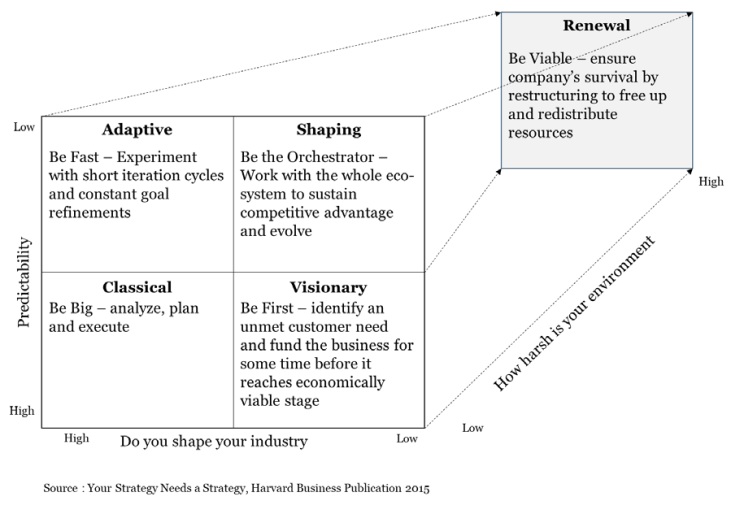
Companies take a technology first approach instead of business first approach
Many companies across industries are adopting digital technologies like analytics, cloud, mobile, social media and more recently Internet of Things (IoT) to engage customers innovatively, provide greater possibilities for their employees and optimize or redefine operational models. While it is fascinating and heartening to see how digital is revolutionizing several industries and the very nature of businesses itself, companies must also realize that digitalization potential varies across businesses and industries. A comprehensive view spanning front office, mid office and back office is essential to define and drive business and operational outcomes. Trying to adopt digital technologies just because your competitor or industry is doing so will not yield the desired benefits, especially in the absence of a business-focused goal.
Companies run a digital transformation agenda with traditional processes
Having a strategy and technology is insufficient for companies to achieve digital transformation fast enough or in a good enough way. Digital transformation Singapore is a fundamental shift in the way people think about how they interact, collaborate and work. According to Forbes, a large part of companies failed at digital transformation because these companies were not prepared to change traditional processes. Digital transformation efforts fall flat when companies do not spend sufficient time changing people’s behaviors, culture and how people make decisions. Companies that achieved successful digital transformation identified adaptation to agile ways of working as the critical underlying secret of their successful digital transformation.
Looking ahead
While successful digital transformations are hard to attain, the benefits are extremely rewarding. To stay relevant, companies need to balance both exploitation and exploration and adopt implementation strategies based on the environment their business is exposed to. While doing so, companies need to ensure that the right structures, processes and ways of working are adopted to support the digital transformation initiatives in Singapore.
How can IGPI help you in your digital transformation journey in Singapore?
We understand that technological changes and digital transformation are quite challenging for companies. With this article, we hope you get a deeper understanding of the key constituents necessary for a successful digital transformation program. While these are key underlying themes, there is also no “one size fit all” approach and companies need to employ different strategies based on the unique needs and environment they are operating in. IGPI is known for our corporate turnarounds and transformations and we will be delighted to assist you in strategizing your end-to-end digital transformation initiatives. Our non-exhaustive list of digital transformation capabilities include:
-
- Assessment of company’s position in terms of its digital capabilities relative to competition by benchmarking with traditional and emerging competitors and making recommendations on areas of improvement
- Market research on the technologies that can impact/improve the service offerings of the company and potential ways of implementation
- Developing and validating existing and evolving consumer behavior and preferences
- Reevaluate the existing processes and tools (to free up capital) that support businesses and identify areas of improvement
- Conceptualize new business models through running ideathon to tap on market opportunities
- Execute an incubator or accelerator program that suits the needs of your organization
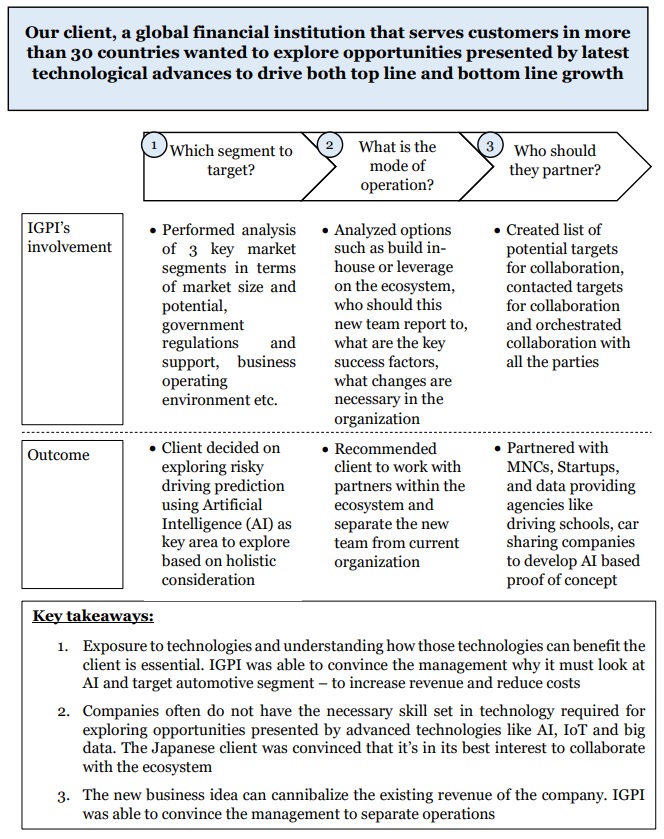
Case study:
IGPI’s digital transformation Singapore advisory support from identifying opportunities to offering execution support.
==========
[References]
[1] What the companies on the right side of the digital business divide have in common; Harvard Business Review, Jan 2017
[2] Adaptability: The new competitive advantage; Harvard Business Review, Aug 2011
[3] Is your company ready for a digital future; MIT Sloan Management Review, Winter 2018 issue
[4] https://www.aia.com.sg/content/dam/sg/en/docs/press-releases/2012/AIA_Introduces_First-in-Market_Technology_to_Insure_Customers_as_Fast_as_Within_One_Day.pdf
[5] http://ecbeez.blogspot.com/2013/06/aia-singapores-ipos-on-ipad-first-in.html
[6] Tomorrow Never Dies: The Art of Staying on Top; BCG Henderson Institute, May 2017
[7] https://inside-packaging.nridigital.com/packaging_jan19/industry_4_0_how_tetra_pak_is_adapting_to_digital_manufacturing
[8] Why 84% of companies fail at digital transformation; Forbes, Jan 2016