


Japan has long been home to companies with world-class technologies, strong brands, loyal customers, skilled employees, and solid balance sheets. Yet these strengths have not always translated into enterprise value. In many cases, the challenge was not a lack of capability, but the failure to translate those capabilities into value through effective capital allocation and strategic choices. The focal point should be turning existing capabilities into sharper strategic choices: where to focus, where to invest, and how to deploy capital to its highest-value opportunities.
As a result, the questions facing Japanese management have evolved. Traditional measures such as revenue, profit, and market share remain important. However, management teams are increasingly asking whether capital is generating sufficient returns, which businesses deserve further investment, and which should be changed, sold, or exited. Japan’s recent corporate value renaissance has benefited from external factors such as the global AI boom, a weaker yen, and global capital flows, but behind these tailwinds lies a structural shift toward greater emphasis on capital productivity, portfolio discipline, and enterprise value.
Japan has spent roughly 25 years working through a corporate value transformation, offering particularly relevant insights for Singapore. It began with corporate restructuring in the 2000s, followed by governance reform in the 2010s and a stronger focus on capital efficiency and portfolio transformation in the 2020s. This evolving focus has coincided with a significant rise in Japan’s equity market, with the Nikkei 225 reaching more than 60,000 as of September 2026. Key milestones included Japan’s Stewardship Code in 2014, the Corporate Governance Code in 2015, TSE market restructuring in 2022, and cost-of-capital and stock-price awareness initiatives in 2023. IGPI was actively involved in this journey through business revitalization, portfolio restructuring, capital reallocation, and contributions to governance reform in Japan.
However, while Japan’s journey could offer relevant insights, Singapore need not follow the same path. The two markets differ in terms of size, international exposure, ownership structures, and Singapore’s distinctive role as a regional hub. Rather than mechanically replicating Japan’s experience, Singapore can adapt the underlying principles to its own strengths and circumstances.
Event Overview
Following its appointment by Singapore Exchange (SGX) as an eligible service provider for Corporate Strategy and Financial Management under the Value Unlock Program, IGPI Singapore hosted “The Value Unlock Journey: Lessons from Japan for Singapore” on 22 September 2026.
In his opening remarks, Geoff Howie, Market Strategist at SGX, noted that the Straits Times Index recorded 0% growth between 2006 and 2016 while nominal GDP grew 8%. The gap showed that economic growth had not translated into equity-market performance over that period. In response, MAS and SGX launched the Value Unlock initiative aimed at helping Singapore-listed companies understand their valuation drivers and strengthen how they create and communicate long-term shareholder value.
IGPI’s keynote examined how management thinking and decision-making have evolved through Japan’s corporate value renaissance and highlighted lessons relevant to Singapore. The subsequent panel discussion brought together Geoff Howie, and Mark Wong, Head of Group Strategy at ST Engineering, alongside IGPI, to explore how Singaporean companies can use these lessons in practice. The discussion focused on how strategic and portfolio choices can be translated into execution, how companies can balance present performance with future opportunities, and how progress can be made visible to investors.

Geoff Howie, Market Strategist at Singapore Exchange, delivering the opening remarks.

Kohki Sakata, Partner of IGPI Group, delivering the keynote address.
Key Insights
Drawing on lessons from Japan’s corporate transformation and practical perspectives from Singapore, the following insights highlight what it takes to build sustainable enterprise value.
1. Value Creation Starts with Better Management Decisions
In the keynote address IGPI shared that enterprise value creation starts with better management decisions. Governance creates value when it improves decisions on capital allocation, portfolio composition, investment, and exit, not merely by introducing structures and processes.
The quality of these decisions is ultimately reflected in how the market values a company. Metrics like price-to-book ratio (PBR) can signal whether investors believe management can generate sufficient value from the capital entrusted to the company. However, improving the ratio is neither the objective nor a strategy. Buybacks may improve a financial ratio, but financial engineering without an underlying strategy does not improve the business. The objective is to build a better company by improving capital productivity and creating sustainable value.
This emphasis on decision quality also applies to how companies balance present performance with future growth. The panel discussion further explored this balance, with Mark Wong describing three broad areas for capital allocation: growth in the existing business, new and adjacent businesses, and longer-term opportunities. The proportions will differ by company, but the principle is to allocate deliberately across current and future opportunities rather than allowing short-term pressure to absorb all available resources. Longer-term visions can help management determine which near-term actions matter and how capital should be allocated.
Singapore-listed companies should begin with a clear assessment of where the company can create the greatest value. This includes determining how capital should be allocated across existing, adjacent, and longer-term opportunities. PBR improvement should be viewed as an outcome of these decisions, rather than the objective itself.
2. Conglomerate Discount to Conglomerate Premium: Portfolio Transformation Requires Strategic Coherence
The purpose of portfolio transformation is to reallocate capital and management attention from lower-priority activities to stronger opportunities. This requires an honest assessment of each business: Is the market attractive? Does the company have a competitive advantage? Does the business create value relative to its cost of capital? And is it strategically relevant to the group? These questions should inform portfolio transformation decisions to either exit, sell, focus, or reinvest.
As mentioned in IGPI’s keynote address, portfolio transformation can narrow a conglomerate discount but closing that gap is only part of the task. The businesses in a portfolio need a clear reason to belong together and must be demonstrably stronger as a group. However, strategic coherence alone is not sufficient. A conglomerate premium becomes possible when the group can demonstrate that the economic value created through shared capabilities, customers, technologies, or other synergies exceeds the costs and complexities of operating as a group.
Hitachi, for example, divested non-core businesses while defining a clearer core around Digital-led Social Innovation, building capabilities through Lumada, acquiring GlobalLogic, and establishing Hitachi Digital Services. The broader lesson is that companies need to remove what no longer fits and strengthen the connections between what remains. Aspects such as shared capabilities, customers, technologies, regional platforms, or investment capacity can provide a compelling reason for businesses to belong together.
3. Strategy Creates Value Through Execution
Strategy begins to create value when it changes concrete actions such as how capital is allocated, where investments and divestments are made, how the organization is structured, and how operations are run. The link between strategy and value creation is therefore execution: turning management choices into tangible changes in the business and, ultimately, into performance.
ST Engineering’s transformation provides a practical example. When the pandemic severely affected businesses such as Commercial Aerospace, the company did not simply pull back on investment. It used the period to sharpen its group-wide strategy and redesign its organization and business portfolio. Its complex business structure was reorganized into clearer clusters, while dispersed engineering and technology capabilities were consolidated and scaled. The company also divested businesses, pursued major acquisitions aligned with its strategic priorities, and communicated clear targets to the market. The company also communicated performance targets to investors, providing a basis for assessing progress against its strategic priorities. The example shows that execution is not a separate stage that follows strategy. It is the process through which strategy becomes visible in the business.
4. Value Creation Must Be Visible to Investors
Companies must give investors a clear basis for assessing whether their strategy is working. This requires linking financial results to the operational drivers behind them. In the REIT market, for example, investors look beyond DPU and NPI to factors such as asset disposals, acquisitions, asset-enhancement initiatives and debt reduction. These actions provide tangible evidence of how performance is being created and how capital is being deployed. Depending on the business, relevant drivers may include customer acquisition, capacity utilization, portfolio productivity, technology adoption or market expansion. These drivers should be specific, measurable, and clearly linked to financial outcomes, enabling investors to assess not only whether management is executing its strategy, but also whether that execution is creating economic value.
Moreover, investor communication should connect these operational drivers to the broader value-creation story. Its role is to help the market understand how strategy, portfolio choices, capital allocation, and execution work together to create value. An equity story should therefore be more than a communications exercise. It should demonstrate that management’s strategy is coherent and that its decisions can be linked to tangible business outcomes.
As Geoff Howie emphasized, companies cannot assume that investors already understand their businesses. Singapore-listed companies need to explain what they do, why they remain relevant, where they are going and what gives them the right to play. This is particularly important for smaller companies and those operating in specialized sectors, whose capabilities may not be sufficiently understood by the broader investor community. Communication cannot substitute for strategic clarity or credible execution. However, it can make the link between strategy, action and value creation easier for investors to understand.
Conclusion
A central lesson from the discussion is that building sustainable enterprise value is not a one-off initiative or an exercise in improving short-term valuation. It is an ongoing management journey of turning a company’s strengths into value. What ultimately matters is whether management choices lead to meaningful changes in the business and measurable outcomes.
Singapore does not need to repeat Japan’s 25-year journey. Japan’s experience offers positive lessons and important warnings: governance, financial engineering, and communication are not substitutes for real strategic and operational change. While Japan’s transformation evolved over time through restructuring, governance reform, and greater capital discipline, Singapore has an opportunity to address these dimensions as an integrated management agenda. For Singapore-listed companies, the priority is not simply to improve market valuations, but to connect portfolio strategy, capital allocation, operational execution, and investor communication in a way that creates sustainable enterprise value.
IGPI’s Approach to Value Unlock
At IGPI, we believe that unlocking corporate value requires more than identifying opportunities for improvement. It requires a clear understanding of how business strategy, portfolio decisions, capital allocation, and operational execution work together to create value and how ultimately that is reflected in market valuations. Our approach begins by identifying where value is being overlooked, where new value can be created, and where existing value is being lost. From there, we help management determine which businesses to prioritize, where to invest capital, and what operational changes are needed to deliver results. Moreover, we ensure that these decisions translate into measurable outcomes and a clear investment story, so that the value created by the business can be better understood and recognized by investors.
What differentiates IGPI’s approach is its combination of strategic advisory, investment, and hands-on business management experience. Having worked not only as an advisor but also as an investor and business operator, IGPI approaches value creation from the perspective of those responsible for delivering results. This enables us to connect board-level strategic decisions with the operational changes required to implement them, rather than treating strategy development and execution as separate activities.
Following its appointment by SGX as an eligible service provider for Corporate Strategy and Financial Management under the Value Unlock Program, IGPI Singapore looks forward to drawing on the experience and lessons accumulated through Japan’s corporate transformation, adapting them to Singapore’s own strengths and circumstances, and contributing to sustainable enterprise value creation among Singapore-listed companies.
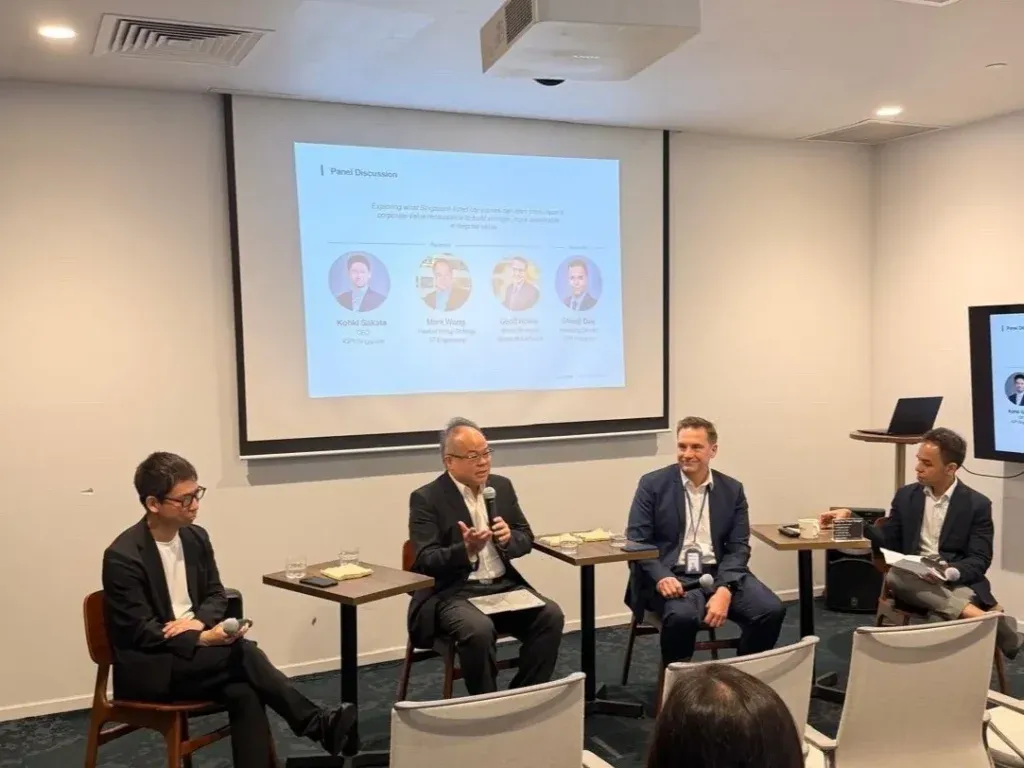
Panel Discussion featuring (from left) Kohki Sakata, Partner of IGPI Group; Mark Wong, Head of Group Strategy at ST Engineering; Geoff Howie, Market Strategist at Singapore Exchange; and Shivaji Das, Managing Director of IGPI Singapore.