

With the uncertainty and economic turbulence triggered by the COVID-19 pandemic, companies need to adapt and innovate to survive in the long term. Although the importance of innovation is widely understood by top management, driving and maintaining innovation can often fall short when faced with more immediate corporate priorities such as cost cutting and cash flow management. Risk aversion in time of crisis can become entrenched and hinder the culture of bold experimentation required for successful innovation.
This article discusses the importance of innovation to achieve long-term growth, the mindset and culture required to drive innovation, the considerations to form actionable ideas aligned to innovation strategy, the process of managing innovation and the approaches to cultivate innovation.
Utilize innovation as a critical lever to achieve long-term growth
At a time when the pace of innovation is dramatically compressing cycle times, not preparing for the future creates business risk. While it is tempting for businesses to weather the uncertainty either by taking a “wait-and-see” approach or a defensive cost cutting approach, we believe that companies need to focus on both top line and bottom line growth. Focusing only on cost cutting will tend to impede top-line growth since companies will not be positioned to take advantage after the crisis ends.
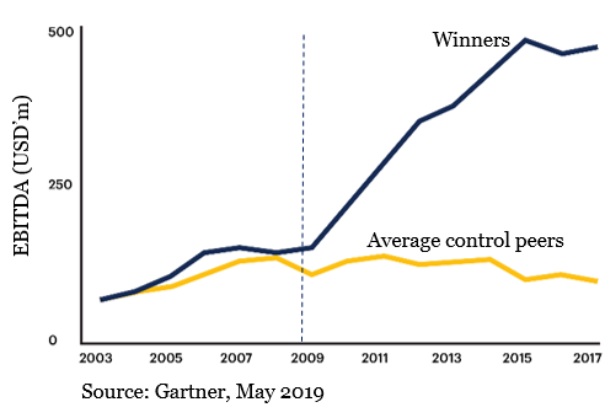
This aligns with the 2019 study conducted by Gartner on the fortune 1,000 companies. The survey observed that companies that focused on both top-line and bottom-line growth during the 2008 recession emerged as top of their industries in terms of revenue, margin improvement and long-term growth.
According to its survey, outperformers posted a 13% annualized growth rate in earnings before interest, tax, depreciation and amortization (EBITDA) between 2009-2017, compared to a 1% annualized contraction in EBITDA among the control group.
Inculcate an explorer mindset – Encourage risk taking and accept failures
Traditional corporate culture of rewarding success and inaction while punishing failure is an obstacle for innovation. As the process of innovation requires exploration and taking risks, companies must rewire their culture and norms to tolerate and value risk. Innovative organizations have embraced an explorer’s mindset, marked by a constant search for new ideas and a passion to solve fundamental problems for the company’s customers and employees. Companies can empower employees by providing them with channels and resources for them to pursue innovative ideas independently. Adobe’s Kickbox program has successfully provided a toolkit to encourage and guide employees to contribute ideas, and has since become an open-source material used by other organizations.
Commitment and direct involvement from top management is also crucial to inculcate an innovative culture. While there might be a trade-off between short-term performance and investment in innovation, top management needs to create a clear vision and strategy for innovation with communication and allocation of sufficient resources.
Innovation can be broadly classified as sustaining innovation to improve current products within existing businesses and disruptive innovation to discover new products and markets. It is hard for disruptive innovation to happen within most established companies as incentives for business units are aligned to the existing businesses. As such, new business units with new business models are needed for disruptive innovation. External avenues to innovation that are kept separate would be viable as well.
Work on actionable ideas aligned to your strategy that can be monetized
Though it is often tempting for companies to measure innovation by R&D spending in absolute terms or as a percentage of total revenue, studies have shown that there is little correlation between both of them. While R&D spending is an indication of commitment to grow, R&D typically focuses on technical aspects which might not coincide with the needs of customers. Innovation should have needs of customers — either existing or future — in mind.
Innovative companies often have clear innovation strategies that typically have a society and customer-centric focus. Amazon has adopted a data-driven and customer-focused innovation approach, using artificial intelligence to understand customer behavior in order to predict what they might want next. Typical questions that help companies to choose focus areas include:
-
- What are the key challenges of the future? Do customers have needs that they want to be solved?
- In which areas does the company hold the greatest pockets of knowledge, competence, and resources, and how can they be leveraged?
- Which market segments should the company target?
- How do customers define value, and what are the key considerations by which we can create a compelling value proposition for them?
- What data should the company generate during development to prove the value proposition?
- Can we make money from the value proposition?
- Is the value proposition aligned with our strategy?
- What revenue and profit targets need to be achieved?
- What resources are available for reinvestment?
While there will always be a strong element of risk in innovation, the process of managing innovation should never be haphazard or risky. A holistic and data-driven approach to prioritizing innovation investments can increase R&D efficiency and greatly reduce the risks of research bottlenecks and wasted R&D resources.
Develop a formal process for managing the innovation process
Poor management of innovation processes in the organization can have huge long-term economic and strategic implications. A poor process could result in under-utilized capabilities, focusing on unrealizable projects, lack of vision on desirable outcomes, misallocation of resource and no results.
Companies that aptly manage their innovation efforts stand to gain an edge over their competitors. Innovative cultures require guiding structure of governance and process to be effective. As innovation requires starting with numerous ideas before narrowing them, it is important to know when to stop investing in faltering ideas or projects. There should be stringent capital controls, resource allocation mechanisms and clear processes in place to guide projects or kill them.
Explore internal and external avenues to innovation
Innovation approaches should complement each other; hence companies should deliberately construct and operate their portfolio of approaches. In addition to openness to ideas created in-house and from internal R&D departments, companies must be open to sources of new ideas through engagement with a broader external ecosystem. Experienced innovators employ a variety of approaches to generate innovation. The portfolio of external approaches include corporate venture capital, business accelerators, incubators, acquisitions and partnerships with the broader ecosystem.
Knowing where you are today helps you set the course and prioritize what needs to happen next. It also helps you to strategize your move – either succeed as a disruptive innovator or defend against a disruptive challenger. The following questions are useful to determine which approach best suits your needs:
-
- How much resources (time, money, human resources) can you allocate internally and externally?
- Do you want to focus on growth of your existing businesses or discover disruptive ideas and new businesses?
- Do you employ enough approaches to constitute a diverse portfolio? Are those approaches aligned with clear objectives?
Highly innovative companies collaborate with an ecosystem of external organizations to tap into specialized expertise and broader talent pools, to build tools and solutions without bearing the full cost and to gain exposure to new ideas and business models.
How can IGPI help you in your innovation journey?
Established companies should encourage innovation by fostering a risk taking organizational that is in line with a clear strategy for innovation focused on customer needs. Companies need to understand that innovation is a journey and there is a need to review their portfolio approach from time to time to make sure they are focusing on the right opportunities that aligned with the changing needs of the business. For that reason, businesses must engage with strategy consulting firms to make strategic business decisions.
Based in Singapore, IGPI has the end-to-end capabilities in supporting your innovation journey. As a management consulting firm, we can help you by both looking inside and outside to identify best opportunities that align with your strategy and core capabilities. Here is a representative list of our capabilities to serve your innovation needs:
-
- Internal change management to shape an innovative culture through empowering employees
- Discover new growth areas by exploring adjacencies where your organization has opportunities and capabilities to win
- Identify disruptions and emerging trends that your business should be aware of and embrace
- Identifying the areas where your competition are placing bets and which emerging players are most interesting or threatening
- Review, align and restructure innovation initiatives to identify loss-making initiatives and focus on the key issues
- Identify the critical capabilities required and define the best path to obtain them whether through corporate venturing, partnership, acquisition, or internal development
- Support for acquisitions, running an accelerator program, identification of partners
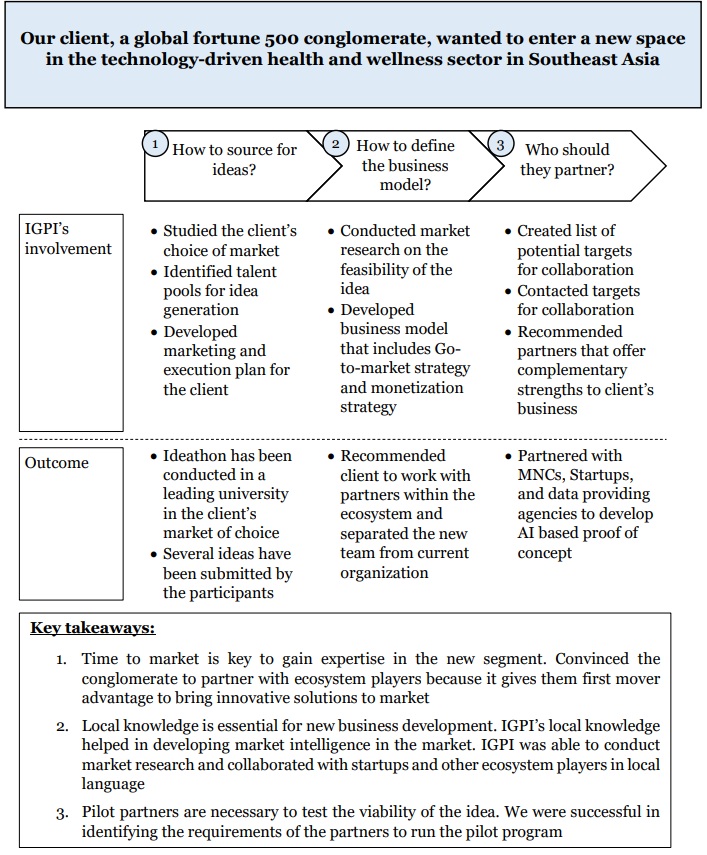
Case study:
IGPI developed the concept of ideathon and developed a business model from the ideas shortlisted from the ideathon.