
As cross-border M&A activity continues to expand across Asia-Pacific, post-merger integration (PMI) is becoming one of the most important factors determining whether transactions ultimately create long-term value. While financial models, legal structures, and synergy assumptions remain central to deal-making, organizations are increasingly recognizing that unexpected integration challenges emerge when businesses with very different operating cultures, governance styles, and decision-making structures are brought together.
This article summarizes key insights from the Post-Merger Integration Conference (PMIC) 2026, highlighting discussions around cross-border integration, organizational alignment, corporate culture, governance, and operational execution across Asia’s dynamic M&A landscape.
PMIC 2026: Integration Challenges Across Asia’s Growth Markets
The Post-Merger Integration Conference (PMIC) 2026, organized by the Institute for Mergers, Acquisitions and Alliances (IMAA) and Mergers & Acquisitions Association Singapore, brought together M&A leaders, legal advisers, integration specialists, investors, and corporate executives for discussions on post-merger execution and long-term value creation.
Held at the Mandarin Oriental Singapore, the event featured case studies, regional integration discussions, operational deep-dives, and networking sessions focused on the evolving realities of cross-border M&A.
The conference covered themes including culture integration, governance structures, technology alignment, legal risk, operating model integration, regulatory complexity, fiduciary responsibilities, and synergy realization. Several sessions focused on practical lessons from transactions across Southeast Asia and Northeast Asia, where businesses often operate under very different organizational norms despite increasing economic integration.
One of the recurring themes across the conference was that integration challenges often emerge because organizations underestimate the complexity of aligning leadership expectations, communication styles, decision-making processes, and operating cultures after closing. Across multiple discussions, participants emphasized that successful post-merger integration depends as much on trust and organizational alignment as it does on technical execution.
IGPI at PMIC 2026: The Relational Side of M&A Integration
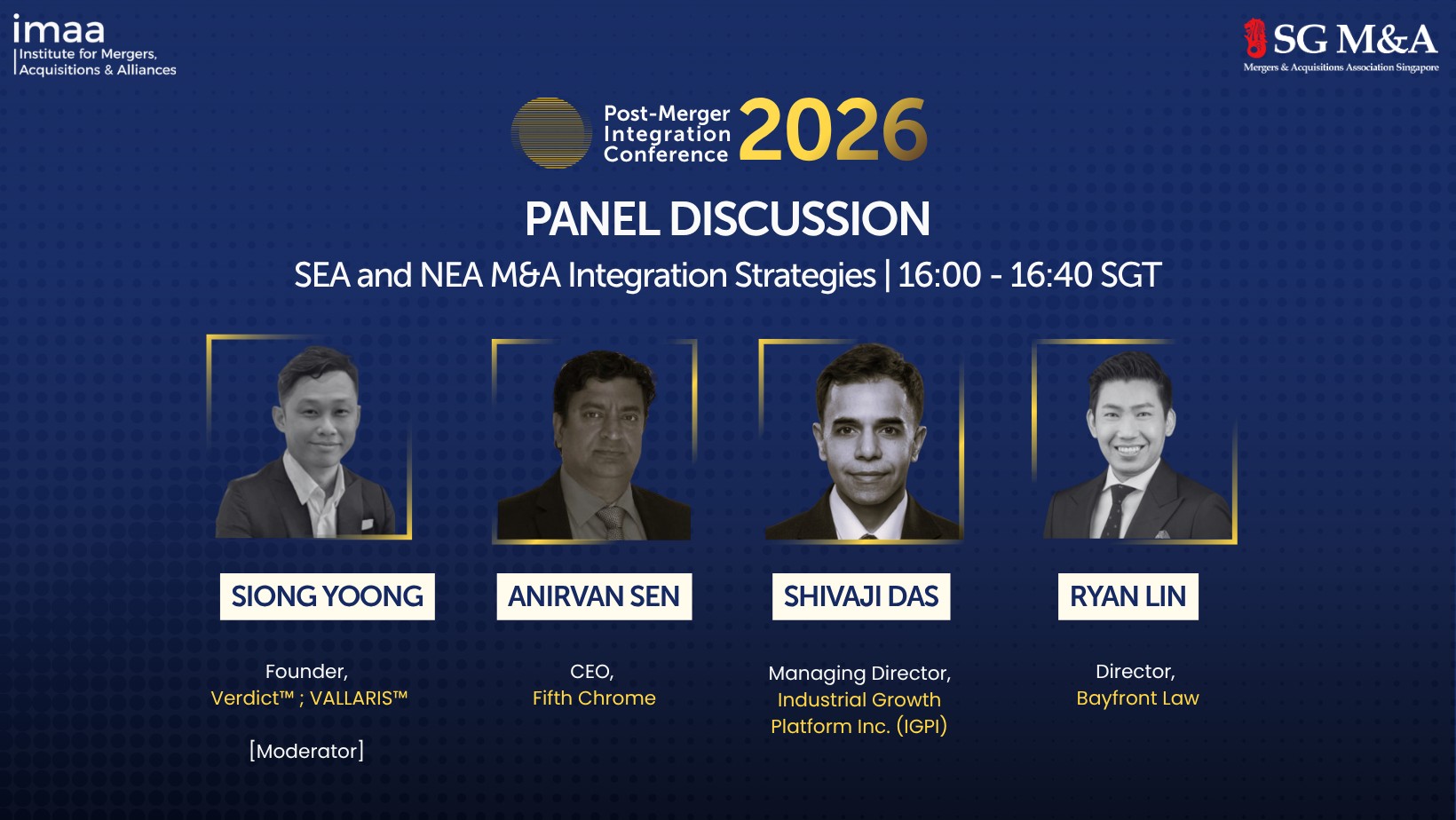
At the conference, IGPI participated in the panel discussion on post-merger integration strategies across Asia. The session featured Shivaji Das, (Managing Director – IGPI Singapore), along with Markus Schneider, (Founder & Managing Partner, Cobalt Value Partners), and Ryan Lin, (Director, Bayfront Law LLC). Siong Yoong, Founder, Verdict™ & VALLARIS™, served as the moderator.
The discussion focused on practical lessons from cross-border M&A integration across Southeast Asia and Northeast Asia, particularly around governance, culture, legal risk, and operating alignment. Some of the key insights from the panel and the other discussions are as follows:
1. M&A in Asia Is Also a Relational Exercise
People are the most important factor when it comes to PMI. Successful integration in Asia depends not only on financial and legal execution, but also on how organizations manage relationships, communication, and trust after closing.
Companies across Southeast Asia and Northeast Asia often operate with different assumptions around hierarchy, consensus-building, communication, and decision-making. These differences become particularly important during integration when organizations are expected to operate under common leadership and governance structures. In such contexts, integration challenges often emerge not because the strategy was wrong, but because the effort required for organizational alignment was underestimated.
2. Culture Directly Impacts Integration Success
Several discussions across the conference reinforced that culture cannot be treated as a secondary workstream after closing.
Different approaches to hierarchy, communication, consensus-building, and escalation often slow decision-making and create misalignment between headquarters and local operating teams. Integration challenges typically emerge gradually through delayed decisions, talent attrition, operational disruption, and declining employee confidence.
Organizations that invest early in trust-building, leadership alignment, and structured communication frameworks generally experience more stable integration outcomes than those focused only on systems and operational consolidation.
Cross-border M&A integration across Asia involves additional challenges arising from differences in regulations, governance models, reporting standards, operating practices, technology systems, and supplier ecosystems.
3. Integration Problems Usually Begin During the Early Months
About 70–90% of M&A transactions arguable fail to deliver expected value.
Common causes include unrealistic synergy assumptions, insufficient due diligence, poor operational integration, unclear ownership structures, and weak execution governance.
Value erosion during PMI often begins gradually during the first few months after closing.
Employees become uncertain about reporting structures, decision-making slows down, and local teams lose responsiveness while waiting for direction from headquarters.
In Asia in particular, companies continue to rely heavily on local leadership relationships, founder networks, and market-specific operating models – factors not completely captured even by the most extensive due-diligence.
Over-centralization too early in the process can therefore disrupt commercial continuity and weaken operational execution. Leadership communication, governance clarity, and talent retention during this early integration period therefore become crucial.
4. Successful PMI Needs to Begin Before Day 1
Effective PMI begins before deal closes rather than after Day 1.
Early planning around governance structures, decision rights, integration priorities, synergy tracking, and operational readiness significantly improves execution outcomes.
Strong Integration Management Offices (IMOs), structured governance cadence, KPI tracking, and rapid issue escalation mechanisms are increasingly becoming critical parts of successful PMI execution. At the same time, organizations that communicate clearly, retain key talent, align leadership expectations, and balance global governance with local flexibility tend to achieve more stable integration outcomes over the long term.
5. Empowered Integration Management Offices (IMOs) Are Becoming Central to PMI Execution
As transactions become more cross-functional and cross-border, the role of the Integration Management Office (IMO) is becoming increasingly important in driving execution discipline and accountability across the PMI process.
An effective IMO structure typically combines executive oversight with dedicated functional integration teams across areas such as finance, HR, IT, legal, operations, procurement, and commercial functions.
Clear ownership, defined decision rights, structured escalation paths, and regular reporting cadence are essential to maintaining execution speed and alignment across workstreams.
Successful IMOs also balance strategic oversight with operational execution. Executive leadership provides direction on priorities, trade-offs, and resource allocation, while integration teams manage detailed implementation, dependency tracking, KPI monitoring, and issue resolution across day-to-day operations.
Conclusion
In summary, PMIC 2026 reinforced that successful post-merger integration across Asia depends not only on financial discipline and legal execution, but also on how effectively organizations manage trust, communication, leadership alignment, and cultural integration across different operating environments.
As cross-border M&A activity across Asia-Pacific continues to grow, companies will increasingly need to approach PMI as both a strategic and organizational challenge — requiring equal focus on systems, people, governance, and long-term operating alignment.
IGPI and Cross-Border M&A
IGPI has been supporting clients across the entire cross-border M&A lifecycle, providing integrated advisory services spanning strategy, due diligence, financial valuation, transaction structuring, and post-merger integration.
Our key differentiator is our multidisciplinary team, bringing together expertise across governance, finance, IT, HR, operations, and strategy to deliver high-impact PMI results with very lean times on an accelerated timeframe.
This enables IGPI to support corporates, investors, and acquisition targets across sectors including energy, industrials, infrastructure, chemicals and digital industries on M&A themes involving growth, technology access, operational transformation, and regional expansion globally.
With extensive experience of facilitating over 150 M&A deals in the past 5 years, IGPI has established itself as a trusted partner for end-to-end M&A advisory and post-merger integration.