

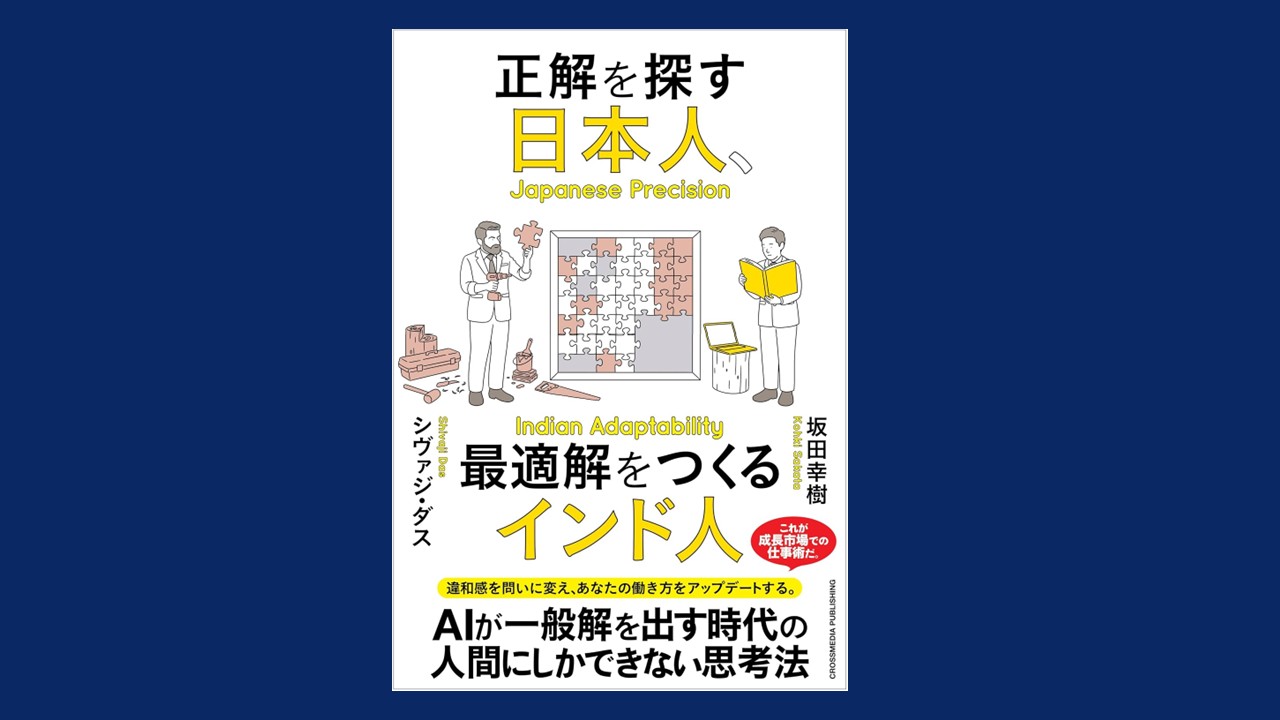
On 7 August 2026, IGPI Group Partner Kohki Sakata and IGPI Singapore Managing Director Shivaji Das published their co-authored book, Japanese Seek the Right Answer. Indians Create the Optimal Solution, with Crossmedia Publishing (available in Japanese only).
Drawing on decades of experience gained through advising Japanese and Indian companies across a wide range of industries, the book explores why decision-making must evolve in an era where uncertainty has become the norm.
This article shares one of its central ideas: why organisations must move beyond the pursuit of the “right answer” and develop the capability to create—and continuously refine—the “optimal solution” for better business decision-making in an increasingly uncertain world.
The Assumptions Behind Finding the “Right Answer” No Longer Apply
For decades, Japanese companies have built their competitive advantage on a management approach centred on finding the right answer.
The process was deliberate and disciplined. Organisations defined a clear objective, analysed the gap between the current state and the desired outcome, identified the most appropriate course of action, gathered sufficient information, aligned stakeholders, and sought to minimise risk before taking action. This approach enabled Japanese companies to consistently deliver high-quality products and services, becoming a cornerstone of their global competitiveness.
Today, however, the assumptions that supported this model are rapidly becoming outdated. Technological innovation is accelerating, markets are changing continuously, and customer needs are becoming increasingly fragmented. What worked yesterday cannot be assumed to work tomorrow.
In this environment, waiting for complete confidence before acting is itself a risk. By the time a decision has been finalised, the market may already have moved on.
Competitive advantage now depends on something different: identifying the optimal solution based on the information available today, acting decisively, learning from the outcome, and continually refining that solution as circumstances evolve. This shift is redefining how organizations approach strategic decision-making in fast-changing markets.
A Different Approach to Decision-Making: Lessons from India
Through years of working alongside Indian companies, we have encountered a fundamentally different approach to business decision-making.
In India, rather than waiting until there is complete confidence, it is common to move forward with a hypothesis that is only around 70 per cent complete.
This does not imply a lower standard of decision-making. The underlying principle is simple: act early, learn quickly, and improve continuously.
In markets where diversity is high and shared assumptions are often absent, an initial hypothesis is expected to be imperfect. Competitive advantage comes not from getting the first decision exactly right, but from responding with agility through repeated cycles of hypothesis, execution, and refinement. This ability to adapt quickly has become a key capability for organizations operating in uncertain business environments.
AI Generates General Solutions. People Create Context-Specific Ones.
These shifts are being accelerated even further by advances in AI.
AI can now generate well-reasoned answers in seconds by drawing on vast amounts of information. In many cases, however, those answers remain general solutions. They become truly valuable only when they are adapted to the unique context of a company, its customers, and its market. General solutions become context-specific solutions only when they are refined through insights gained from direct experience in the market and accumulated expertise.
One of the most important roles left to human judgment is to transform AI’s general solutions into context-specific solutions.
Transforming general solutions into context-specific solutions requires more than analytical capability. It demands the ability to recognise subtle signals from day-to-day business activities — small inconsistencies, emerging changes, and observations that have yet to appear in the data — and to translate them into hypotheses, test them on a small scale, and refine them through continuous learning.
As AI becomes more capable, the ability to transform general solutions into context-specific solutions will become one of the most importance sources of sustainable competitive advantage.
The Strengths of Japanese Companies Have Not Disappeared
None of this suggests that the strengths of Japanese companies have diminished.
-
- A commitment to staying close to operational realities
- An uncompromising focus on quality
- The discipline to recognise subtle signals and improve continuously
These have long been defining strengths of Japanese business.
The challenge is not whether these strengths remain relevant, but how they are applied. Rather than using them to prove that a decision is “right,” organisations should use them to develop and refine the optimal solution.
AI provides general solutions at unprecedented speed. Japan contributes its strength in precision. India contributes adaptability.
Together, these three capabilities – the speed of AI, the precision of Japanese management, and the adaptability demonstrated by Indian companies – will define a powerful new source of competitive advantage in an age of uncertainty.
About the Book
The ideas introduced in this article represent one of the central themes explored throughout Japanese Seek the Right Answer. Indians Create the Optimal Solution.
Drawing on real-world examples from Japanese and Indian companies, the book examines how the assumptions underpinning conventional decision-making have changed, and what new ways of thinking organisations and individuals need to cultivate to improve strategic decision-making and long-term competitiveness.
Its purpose is neither to portray India as superior nor to criticise Japan. Rather, it seeks to understand the strengths of both, broaden the range of strategic choices available to decision-makers, and offer a practical perspective on navigating uncertainty.
We hope the book will serve as a useful resource for leaders seeking to strengthen their organisations and create new sources of competitive advantage in a rapidly changing world.
[Book Information]
Japanese Seek the Right Answer. Indians Create the Optimal Solution
- Authors:
– Kohki Sakata (IGPI Group Partner & IGPI Singapore CEO)
– Shivaji Das (IGPI Singapore Managing Director) - Publisher: Crossmedia Publishing
- Publication date: 7 August 2026
- Language: Japanese
- View on Amazon Japan