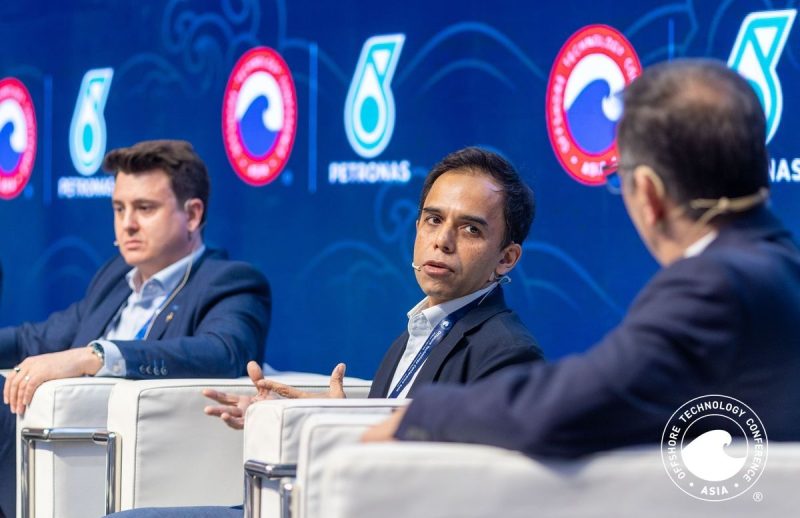

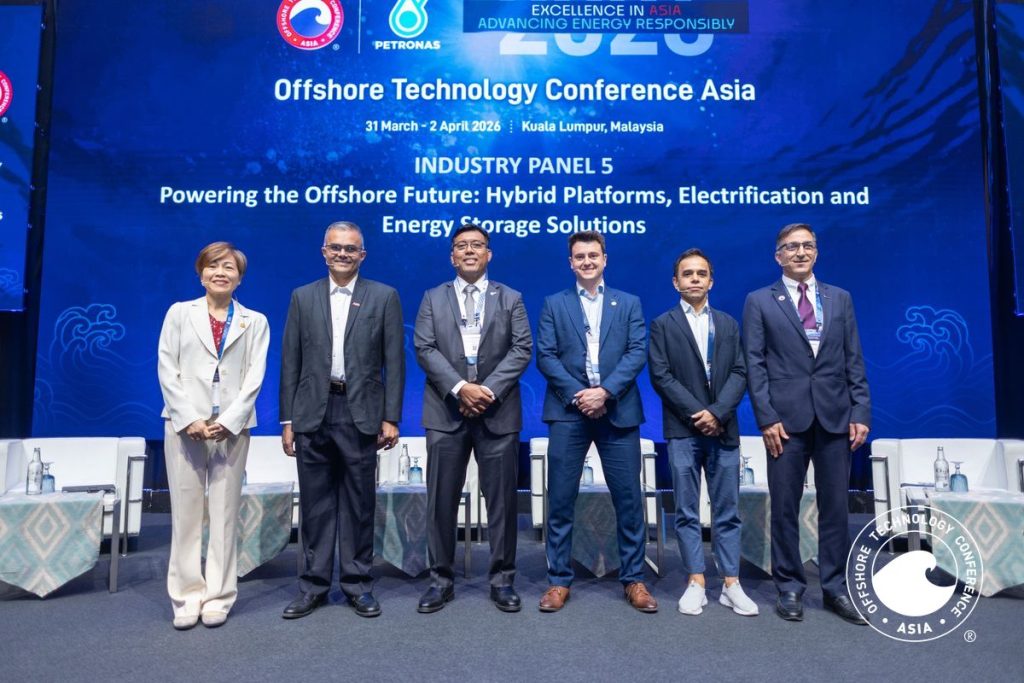
The Offshore Technology Conference Asia (OTC Asia) 2026 took place from 31 March to 2 April 2026 in Kuala Lumpur, Malaysia. This event brought together energy professionals from the Asia-Pacific region and beyond to advance offshore energy innovation and cross-border collaboration.
The event featured over 200 exhibitors showcasing technologies in offshore oil & gas, renewables, subsea systems, and digital solutions. Major participants included PETRONAS, Shell, PTTEP, TechnipFMC, Baker Hughes, Inpex, and ENEOS, alongside emerging technology startups and innovators.
The conference programme also featured region-focused sessions and “Around the World” series discussions with insights on markets such as China, Japan, India, and ASEAN offshore development, reflecting the global scope and diversity of perspectives at the forum. As the offshore sector in Asia continues to navigate the dual imperatives of energy security and decarbonisation, OTC Asia 2026 reinforced its role as a key platform for exploring how offshore assets are being redefined into integrated, multi-energy systems combining oil & gas with renewables and digital infrastructure.
A key contextual factor shaping discussions at OTC Asia 2026 was the ongoing Israel–U.S.–Iran conflict, which has significantly influenced global energy market sentiment and offshore investment risk perceptions.
The escalation has heightened concerns around the security of critical maritime routes, specifically the Strait of Hormuz, which remains a vital corridor for global oil and LNG flows. This has led to:
| ▸ | Increased volatility in energy prices |
| ▸ | Higher insurance and logistics costs for offshore operations |
| ▸ | Stronger focus on energy supply chain resilience across Asia |
Participants universally agreed that the markets and policymakers are underestimating the extent as well as the duration of the supply-shock from the Middle East conflict. Strategic implications for Asia include:
| ▸ | Short-term coal switching to maintain immediate power stability |
| ▸ | Efficiency gains in existing energy plants |
| ▸ | Increased oil and gas exploration in Southeast Asia and other geographies for domestic resilience |
| ▸ | Gradual shift by major economies towards renewable and nuclear energy |
| ▸ | Increased emphasis on regional energy networks and grids in ASEAN and beyond |
| ▸ | Greater collaboration across all industry players along the value chain for faster deployment |
In parallel, discussions at the conference highlighted the growing role of digital integration and systems optimisation, enabling more efficient management of complex offshore energy assets across their full lifecycle. Technologies and opportunities related to Carbon Capture and Storage (CCS) too were a focus from many of the exhibitors at the conference.
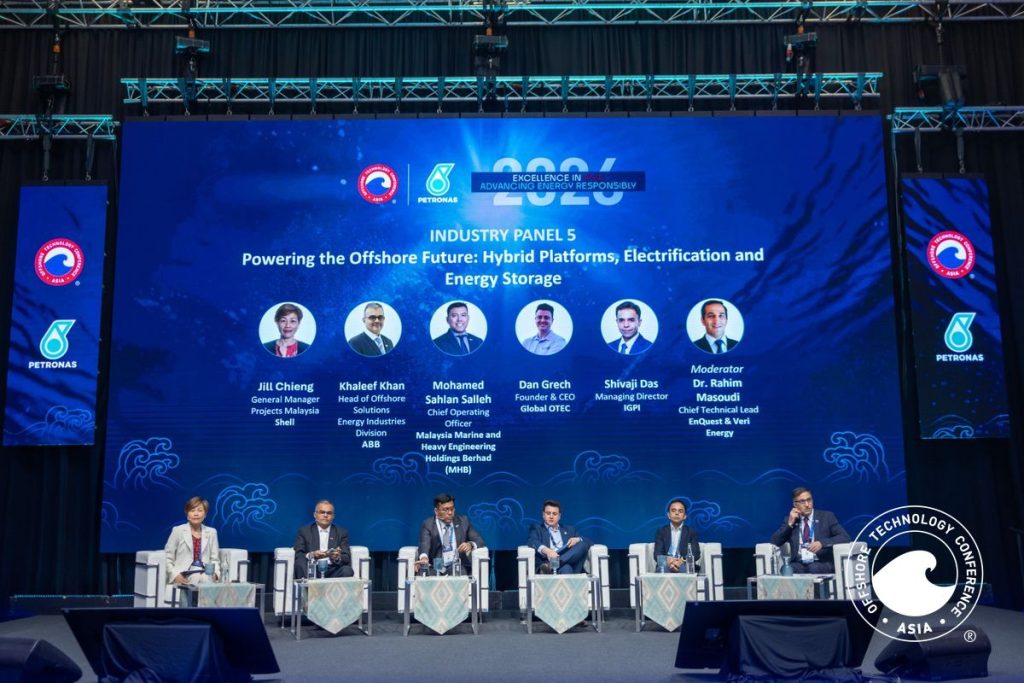
At the conference, IGPI participated in the industry panel: “Powering the Offshore Future: Hybrid Platforms, Electrification and Energy Storage Solutions.”
Shivaji Das, Managing Director at IGPI Singapore, contributed insights on the transformation of offshore energy systems into integrated and flexible energy ecosystems.
IGPI shared that offshore energy is increasingly positioned as the next integrated energy frontier, where assets are evolving beyond single-purpose infrastructure into interconnected energy platforms. These systems are expected to combine hydrocarbons, renewables, carbon capture and storage, and energy storage into unified operating architectures that optimize across multiple energy vectors.
At the same time, the transition will not be uniform across regions, with distinct regional pathways emerging globally based on resource endowment, policy direction, and market maturity. Some regions are accelerating electrification and deep grid integration, while others are prioritizing hybrid gas-to-power models, or modular floating infrastructure.
Beyond technology, market enablers such as carbon pricing, power market design, cross-border interconnections, and utility–oil & gas–investor collaboration models will be critical in determining deployment speed and scalability.
Advancements are being shaped by the dual need for integration and cost efficiency. The sector is moving toward standardized, modular, and integrated design approaches, enabling repeatability and faster deployment across projects. Multi-source energy systems, alongside CCS integration, are emerging as key architecture principles for next-generation offshore infrastructure. These are reinforced by digital capabilities such as AI-enabled optimization, digital twins, cybersecurity systems, and advanced energy management systems, improving operational efficiency and resilience.
In parallel, cost reduction is being driven through shared infrastructure (cables, platforms, pipelines, and hubs), electrification of offshore assets, subsea power grids, HVDC transmission, and cross-border grid synchronization.
Additional enablers such as portfolio-based development, optimized dispatch, carbon pricing mechanisms, and ecosystem partnerships are required to further enhance capital efficiency and accelerating deployment.
The complexity of the offshore transition is reinforcing the strategic importance of M&A and joint ventures as critical execution enablers. As projects become more integrated and capital intensive, there is a growing need for end-to-end capabilities spanning renewables, hydrocarbons, digital systems, and carbon management. Portfolio scale and standardization are becoming essential to achieving cost efficiency and repeatability, driving traditional players to expand into adjacent segments such as offshore wind and solar, LNG integration, and carbon capture infrastructure. At the same time, elevated project risks in offshore environments necessitate collaborative structures.
M&A is increasingly focused on closing capability gaps in renewables, digital, and CCS, while also building scalable asset portfolios and integrated hubs.
Meanwhile, joint ventures and partnerships are emerging as preferred models for asset-heavy developments, early-stage technologies, and region-specific projects, enabling risk-sharing, faster deployment, and broader market access across geographies.
IGPI also shared some of the best practices for M&A in this context based on its recent project experience in the offshore sector.
In summary, IGPI emphasized that future competitiveness in offshore energy depends on building integrated capability ecosystems through partnerships, alliances, and targeted consolidation strategies and supported by a strong enabling policy environment.
To find out more about how IGPI Group can provide support for businesses, browse through our insight articles or get in contact with us.

Shivaji Das, Managing Director of IGPI Singapore
Shivaji has over 20 years of strategy consulting experience, specializing in New Business Models, Innovation Roadmaps, and Sustainability Journeys. He has worked with private and public sector clients across 25 countries in sectors like Technology, Semiconductors, Chemicals, Healthcare, Renewable Energy, and Construction. Previously, Shivaji was a Partner and Managing Director-APAC at Frost & Sullivan. His paper on Artificial Intelligence was presented at CAINE-2000 in Hawaii, USA. He is the author of seven acclaimed travel, art and business books including The Visible Invisibles and Rebels, Traitors, Peacemakers (both Penguin Random House), as well as The Great Lockdown: lessons learned during the pandemic from organizations around the world (Wiley, USA).
He is an alumnus of IIT Delhi and IIM Calcutta.
IGPI Group is a Japan rooted premium management consulting & Investment Group headquartered in Tokyo with a footprint in Osaka, Singapore, Hanoi, Shanghai & Melbourne, as well as parts of Europe and India. The organization was established in 2007 by former members of the Industrial Revitalization Corporation of Japan (IRCJ), a USD 100 billion sovereign wealth fund focusing on turn-around projects in Japan. IGPI Group has 13 institutional investors, including Nomura Holdings, SMBC, KDDI, Recruit & Sumitomo Corporation to name a few. IGPI Group has vast experience in supporting Fortune 500s, Govt. agencies, Universities, SMEs and funded startups across Asia and beyond for their strategic business needs and hands-on support across a wide variety of industries. IGPI group has ~8,500 employees on a consolidated basis.
* This material is intended merely for reference purposes based on our experience and is not intended to be comprehensive and does not constitute as advice. Information contained in this material has been obtained from sources believed to be reliable, but IGPI does not represent or warrant the quality, completeness, and accuracy of such information. All rights reserved by IGPI.

Copyright© 2026 Industrial Growth Platform Pte. Ltd. All rights reserved. Web Excellence by Verz